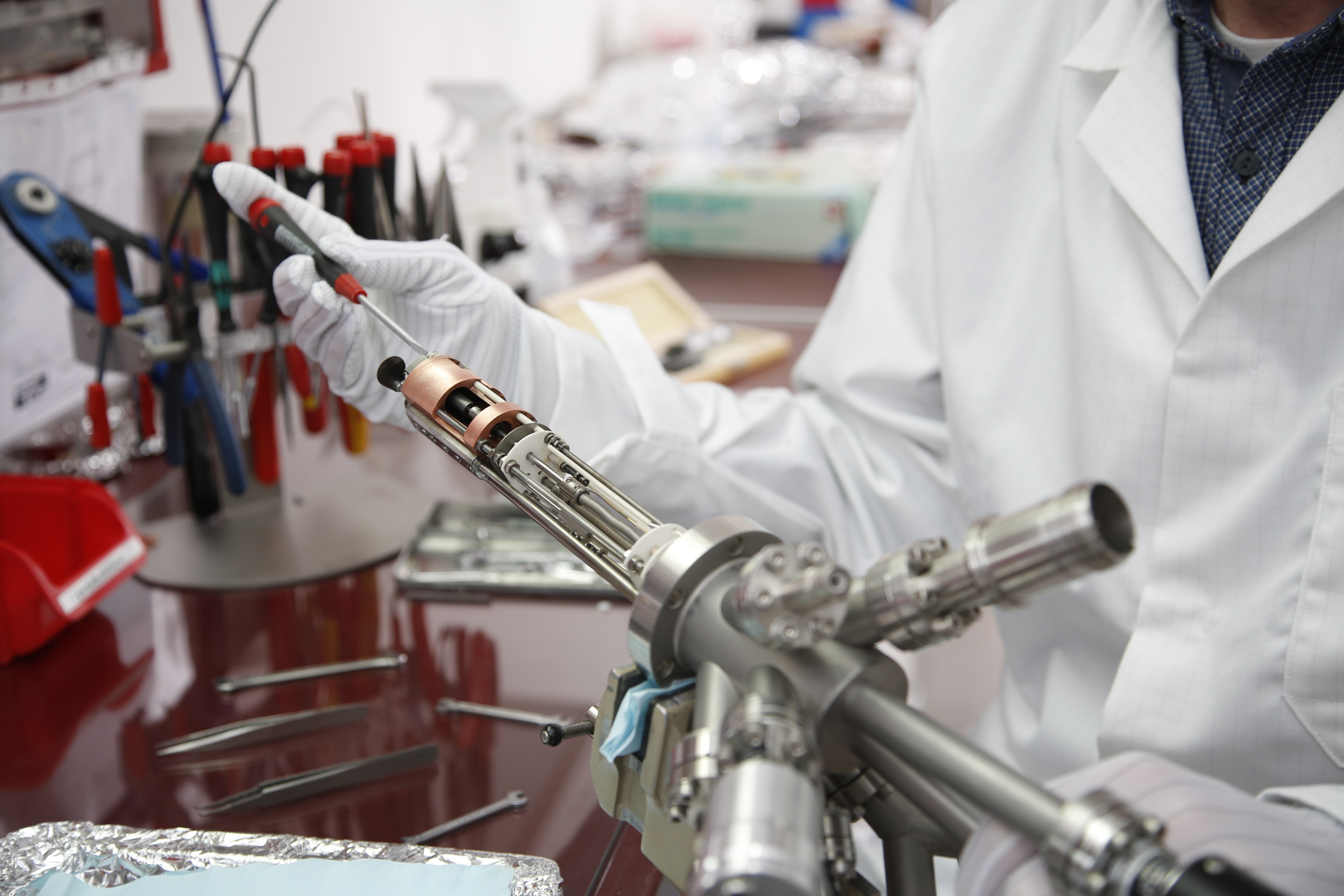
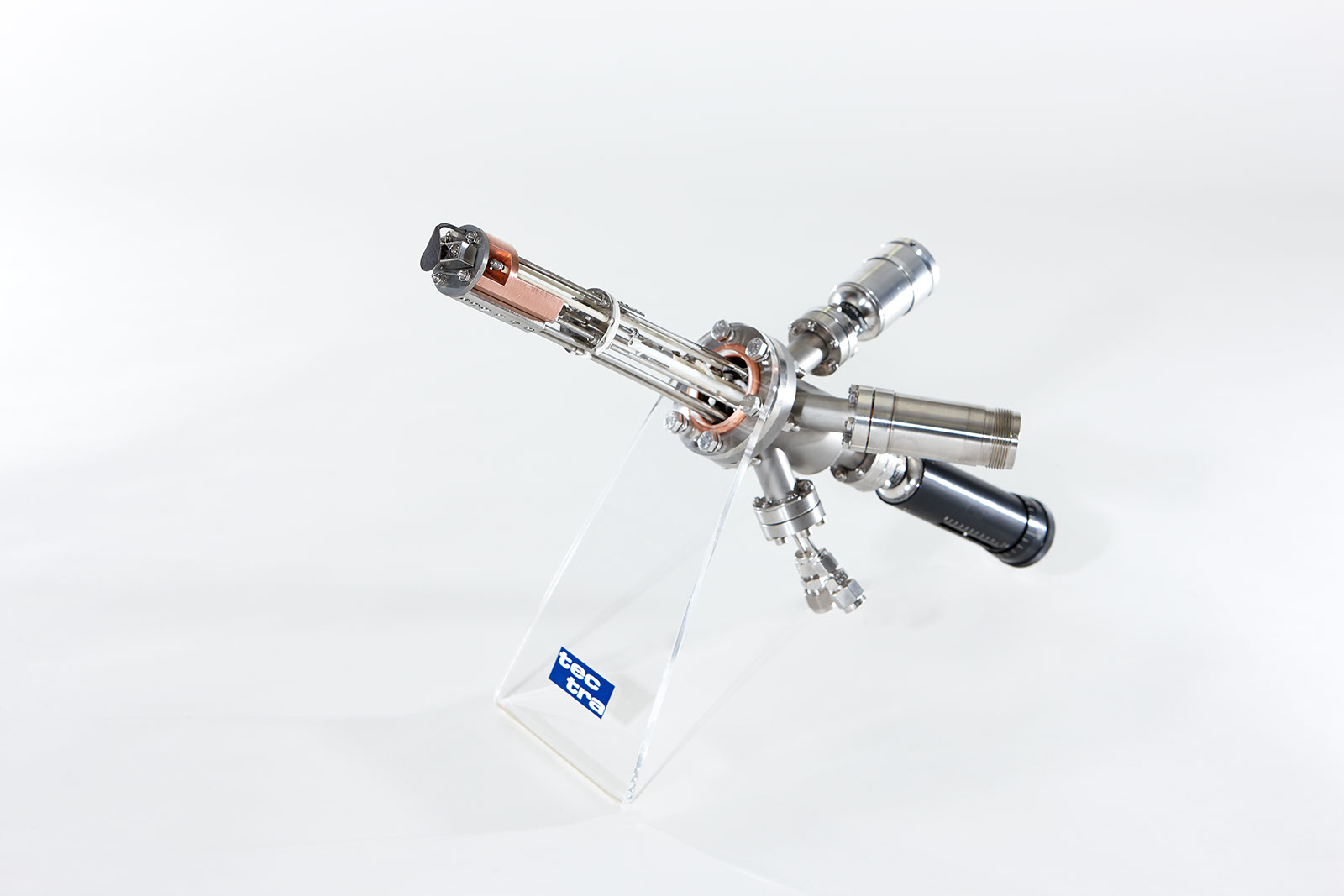
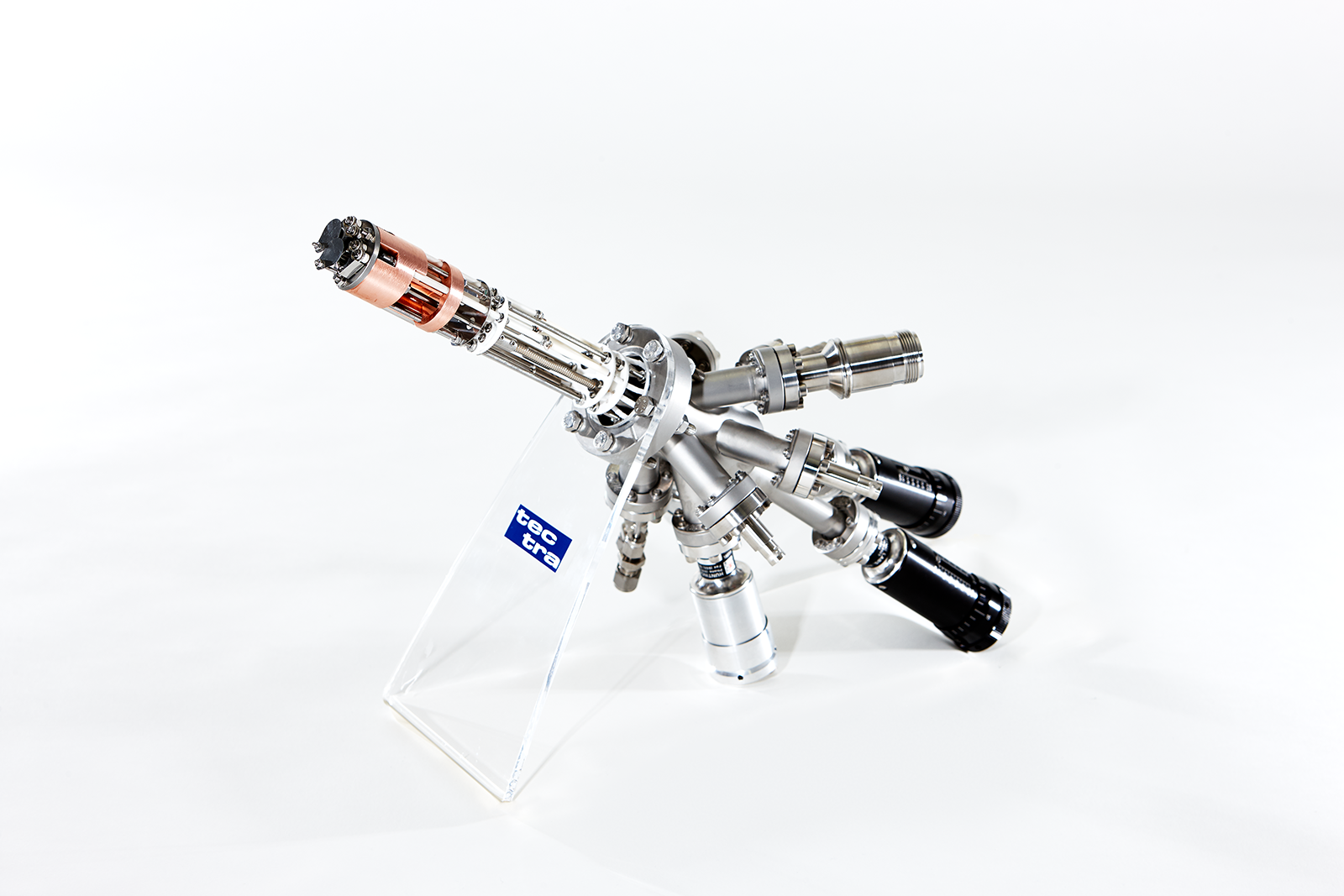
Electron Beam Evaporator E-Beam Evaporator The e--flux Mini E-Beam Evaporator is an UHV evaporator for small and medium quantities of almost any material in the temperature range of 400K to 3100K. Evaporation is possible either directly from evaporant in rod form (Ø2-6mm) or out of a crucible. An integrated flux monitor allows maximum deposition control. Highly efficient watercooling ensures negligable outgassing during operation. The e--flux is very compact and mounted on a standard CF-40 vacuum flange (2.75"OD). It can easily be retrofitted to existing UHV systems as the mounting orientation is virtually unlimited. Main applications are in surface science, thin films and doping for sub-monolayers to >1nm/s.

- crucible and rod evaporation mode
- evaporation of Ø2 and up to Ø6mm rods due to standard 600W power supply
- emission current stabilization
- LED to alert rod feed
- wide range of options (shutter, flux control, thermocouple, crucibles of Mo, Ta, W, C, BN, Al2O3, SiO2)
e--flux Mini e-beam evaporator
e--flux Mini Electron Beam Evaporator, with 50mm rod feed, shutter, flux monitor and thermocouple option
pdf version of e-flux mini e-beam evaporator data sheet (186kB)
Main features of the e-fluc mini e-beam evaporator:
- Evaporation of almost every material possible
- Dual mode operation from rod or out of crucible (e-beam heated effusion cell)
- Simple rugged construction using only standard feedthroughs
- Cost effective pricing
- shutter, flux controller, thermocouple, wide range of crucibles and many other options
Description:A coiled tungsten filament (ground potential) is placed in the immediate vicinity of an electrically conducting crucible or target (high positive potential) and provides electrons which are accelerated towards the evaporant rod/crucible producing extremely high heating-power densities. The evaporation hearth is highly efficient watercooled to ensure negligable outgassing.
The construction is rugged for long term trouble free operation. Only standard feedthroughs are used even for the watercooling lines and the rodfeed to minimise downtime and enabeling the user to self-service in case this should be neccessary.
The filament can easily be replaced and can be self-made using standard Tungsten wire.The power supply is a conventional, rugged design which delivers up to 600W to allow even medium quantities of material to be deposited (>1nm/s). However, fine control of the emission current makes evaporation of very low rates (<0,01A/s) easy and reproducibly possible.
The e--flux can be tailored to almost any application using a wide range of options such as flux monitor, shutter, thermocouple, extended rod feed, many crucible materials,
Modes of Operation:
The e-flux Mini electron beam evaporator can be used to evaporate material in two ways:
- e-beam evaporator mode: The material in rod form is directly bombarded by electrons and rises rapidly to evaporation temperature. Rod evaporation is generally preferable because it creates purest films (only evaporant is heated), no crucible employed (no crucible cost, no alloying) and evaporation from all direction possible. However, some materials such as those with high thermal conductivity and low melting points need crucible evaporation (below). Rod evaporation is suitable for refractory metals and other materials which reach high partial pressures e.g. 10-1 Torr before melting. As material is evaporated, more can be fed into the evaporation zone, using the linear motion feedthrough.
- effusion cell mode: The material is placed in a conducting, usually refractory metal crucible which is heated by electron bombardment causing the contents to evaporate. Optional temperature control of the evaporant via a thermocouple and PID controller make this mode identical to more conventional effusion cells. Effusion cell mode is intended for insulators or other poor electrical conductors and low vapour pressure materials such as gold and aluminium which melt before reaching useful vapour pressures.
![]()
e--flux e-beam evaporator with all options and controller
New Features of the e-flux e-beam evaporator:
This e-beam evaporator - e-beam heated effusion cell - provides a number of new features and advantages over previous designs:
- The power supply is constructed using simple and rugged technology which permits high electron beam powers up to 600W standard to be generated without the use of complex failure-prone electronics.
- The filament is a small coil consisting of several turns of tungsten wire as opposed to ‘hairpin’ and short-wire filaments. Because the filament fully surrounds the target, more uniform e-beam heating with consequently improved flux distribution can be achieved. Replacement filaments are readily fabricated from tungsten wire and easily exchanged thereby minimising operating costs.
- A built-in thermocouple (optional) can be used to monitor and stabilise the target temperature. The thermocouple can be used, as in any other K-Cell as part of a closed control loop comprising a PID controller and the optional control input on the power supply.
- Only standard feedthroughs are used to minimise servicing costs and downtime in case of eventual failures. The watercooling lines are flange mounted (CF16, 1.33"OD) and can hence be disassembled easily. The rod feed driven by a conventional linear motion feedthrough found in most vacuum components catalogues.
- A flux monitor is available. This is an additional electrode which intercepts the edge of the emerging vapour beam. As the vapour leaves the crucible/rod it is partially ionised by the incoming electron beam. Some of the ions will be collected by the flux monitor electrode, generating a small positive current which is related in magnitude to the vapour flux. Besides flux monitor a flux controller (PID) is available to keep the flux automatically constant.
- The large electron emission surface provided by the tungsten coil filament allows higher e-beam powers to be used at lower filament temperatures than in short filament designs, with consequently extended filament lifetime. The filament is simple in form. Replacements may of course be purchased or be easily fabricated by the user from tungsten wire.
- The higher e-beam powers available mean that rods with larger diameters (up to 6mm) may be evaporated or crucibles with larger volumes used (up to 400mm3). This in turn means that higher evaporation rates can be obtained because of the larger evaporation area and that more material may be evaporated before refilling is required.
- The design of the evaporator allows rods of up to 50mm in length to be fed into the evaporation zone.
- The evaporation zone is surrounded by and constructed only from refractory materials and may be outgassed prior to use by switching the HV from the target to the shielding, resulting in direct e-beam bombardment of the evaporation zone materials.
Schematics of the e-flux mini electron beam evaporator (optional items include)
Specification of the e-flux electron beam evaporator: in-vacuum length: 190mm (without options) max in vacuum diameter: 34mm mounting flange: NW35CF (2.75"OD) bakeout temperature: max. 200°C rod feed: 25mm, optionally 50mm crucible volume: 0,3ccm crucible materials: Mo, Ta, W, pyrol. Graphite, BN liner, Al2O3, Quartz deposition rate: from <0,01A/s to >2nm/s beam divergence: ±15° (±12° with flux monitor) e-beam power: max. 600W controller: 19" rack mount, 3U high,
230VAC/50Hz or 115VAC/60Hz or 100VAC/50Hzoptions:
- Shutter (manual and motorised)
- flux monitor / flux controller, Deposition Controller*
- thermocouple
- various crucibles (see above) with end caps for horizontal mount
- motorised rod feed
- control options (schematic)
- others
*Deposition Controller: for many years the flux measurement of the e--flux Mini E-Beam Evaporator has been established to indicate the deposition growth rate. Besides flux monitoring a PID control was available to keep the flux/rate constant.
As a new option we now a Deposition Controller is offered. This extends the flux based possibilities by features as known from quartz microbalances. The Deposition Controller can automatically run a process only by input of the desired film thickness and the evaporation rate.
The Deposition Controller is an ideal tool for users who often want to evaporate different thicknesses or evaporation rates from known material. Parameters of up to 9 materials and processes can be stored after an initial calibration. A user friendly software is provided. Via an RS232C interface the process can be controlled and monitored.
The Deposition Controller needs the flux electrode option and it’s recommendable to have a motorised shutter for automatic end point control.
- reproducable evaporation
- stores up to 9 materials/process parameters
- automatic shutter control
RS232C interface for control and documentation
In the interests of continuous product development, specifications are subject to change without notice.
Quick links to other major tectra products:
Electron Beam Evaporator - 4-pocket e-beam evaporator - Plasma Source - Atomic Hydrogen Source - Sputter Gun - Mini-Coater Deposition System - Sputter-Coater
| contact: | Dipl.-Ing.
Andreas Gati
tectra GmbH, D-60323 Frankfurt, Reuterweg 65, phone: Germany +49 (0)69-720040, fax: Germany +49-(0)69-720400 email: info@tectra.de |
|
| Contact | Home | Products |